
RTP Meaning: Return to Player and Volatility Explained
RTP means Return to Player, the share of all money bet on a game that it pays back over time. So a 96% RTP slot returns $96 for every $100 wagered in the long run, and the house keeps $4.
This page covers the gambling RTP meaning, not the networking protocol or the US real-time payments system.
But RTP says nothing about your next session. Even low house edge dice games that return close to 99% can drain a balance in fifty bets. That’s where volatility comes in, and this page explains both.
What Does RTP Mean?
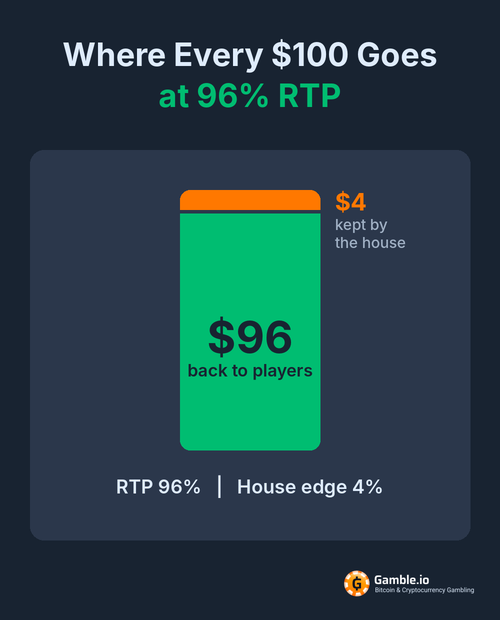
RTP is the percentage of all bets a game is built to pay back to players over its lifetime. Every slot, table game, and crypto original at an online casino has one.
- How it’s calculated: Divide everything a game pays out by everything a player wagers on it, then multiply by 100.
- A worked example: Place 100 spins at $1 on a 96% slot. That’s $100 wagered, and on average $96 comes back.
- Where the house edge fits: The other 4% is the house edge. So the house edge is always 100 minus the RTP, and the two numbers describe the same split.
- Who sets it: The studio builds the RTP into the game’s math, and a test lab checks it before release. The casino can’t change what a single spin pays.
That makes RTP the price tag on a game. A lower number means you’re paying more for the same play.
Why 96% Isn’t a Promise for Your Session
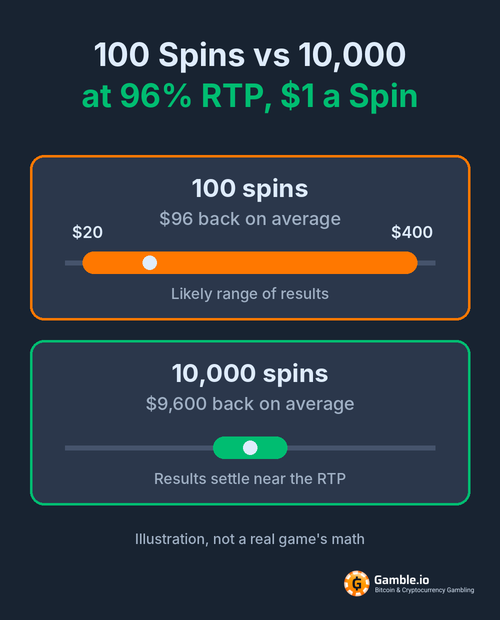
RTP is a long-run average across millions of spins and every player. It isn’t a forecast for your session.
- Over 100 spins: At $1 a spin, you’d expect a 96% slot to return $96. But a high-volatility slot could leave you with $20, or with $400.
- Over 10,000 spins: The expected return is $9,600. The longer you play, the closer your results drift toward the RTP.
- What RTP does: Over enough play, it stops a game from paying out more than it takes in.
- What it can’t do: It can’t tell you a slot is due. Every spin is independent, so a cold run isn’t a sign of anything.
Use RTP to compare games, not to predict tonight.
Is 96% RTP Good? What Counts as a Good RTP
96% is about average for an online slot. What counts as good depends on the game, because table games and crypto originals often return more.
| Game | Typical RTP |
|---|---|
| Most online slots | About 94% to 97% |
| Progressive jackpot slots | Often under 92% |
| Blackjack, basic strategy | 99.5% or more |
| European roulette | 97.30% |
| American roulette | 94.74% |
| Full-pay video poker | 99.54% |
| Crypto dice and plinko | About 99% |
| Nevada casino slots | About 93% |
Card and wheel games return more because their rules fix the odds. Our blackjack house-edge breakdown by variant puts six-deck tables at 0.28% to 0.50%, or 99.5% RTP or better.
A single zero gives Bitcoin roulette a 97.30% return on the European wheel. The American wheel’s double zero drops it to 94.74%.
Plus, played with perfect strategy, full-pay video poker returns 99.54% on Jacks or Better. Baccarat’s banker bet is close behind, at a 1.06% house edge.
However, land-based slots usually pay back less. Nevada’s statewide slot hold averaged about 6.5% over two decades, per UNLV’s Center for Gaming Research. So those machines return roughly 93%.
Then there are jackpot slots, which run lower by design because part of every bet feeds the prize. But on any other slot, an RTP under about 94% usually means a reduced version.
Why the Same Slot Can Pay Back Less at Another Casino
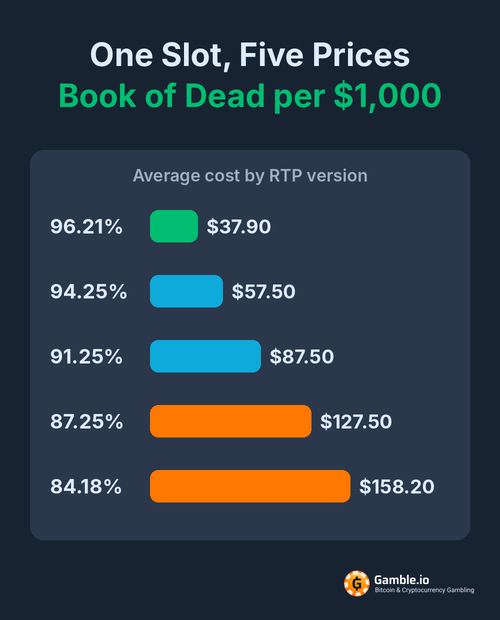
Many studios certify one slot at several RTPs, and the casino picks which version to run. The name, graphics, and features stay the same. The return doesn’t.
| Slot | Certified RTP Versions |
|---|---|
| Book of Dead | 96.21%, 94.25%, 91.25%, 87.25%, 84.18% |
| Gates of Olympus | 96.50%, 95.51%, 94.50% |
But the gap costs real money. $1,000 wagered on Book of Dead loses $37.90 on average at 96.21%. At 84.18%, it loses $158.20.
That’s more than four times the cost, with the same symbols on screen.
That means the RTP you read on a review site might not be the one in front of you. Even Pragmatic Play’s own Gates of Olympus page lists only 96.50%.
- Gamble.io Pro Tip: Open the game’s info panel in real-money mode before your first spin. If the figure sits below the studio’s top version, you’re playing a reduced copy.
We’d go further. Running the reduced version of a popular slot without saying so is charging you more for the same game.
How to Find a Slot’s RTP
You’ll find the RTP in the game’s own rules, and it takes under a minute to check.
- Open the game in real-money mode.
Do it at the casino you plan to play at, since that’s the version you’ll get. - Tap the info or menu icon.
Then open the paytable or the game rules. - Scroll to the bottom of the rules.
Look for “RTP,” “return to player,” or “theoretical return.” - Check for a separate bonus buy figure.
Some slots list one RTP for the base game and another for bought features. - Ask support if nothing shows.
If they can’t tell you, pick a game that publishes its number.
Be careful with demo mode, though. A studio’s own demo can run a different version from the casino’s real-money game.
If a casino won’t show a slot’s RTP, assume you’re playing the lowest version.
What Is Volatility in Slots?
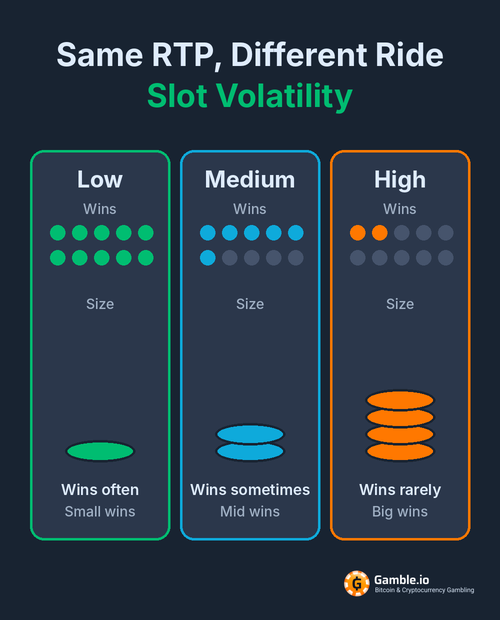
Slot volatility, also called variance, is how a game spreads its RTP. It decides how often you win and how big those wins tend to be.
So two slots with the same RTP can play completely differently.
Low volatility
Small wins land often, and big ones are rare. A $100 bankroll usually lasts a long session, with few sharp drops.
Medium volatility
Wins come less often, but some pay well. Your balance moves up and down without many long dry spells.
High volatility
Most spins pay nothing, and the big wins carry the RTP. A $100 bankroll can vanish fast, or jump on one bonus round.
Hit frequency
The percentage of spins that return anything. Some studios publish it next to the RTP, and it’s worth reading when they do.
Just know that studios use their own scales. Some rate volatility out of five or ten, while others use labels like “extreme.” So compare games from the same studio where you can.
How to Tell a Slot’s Volatility
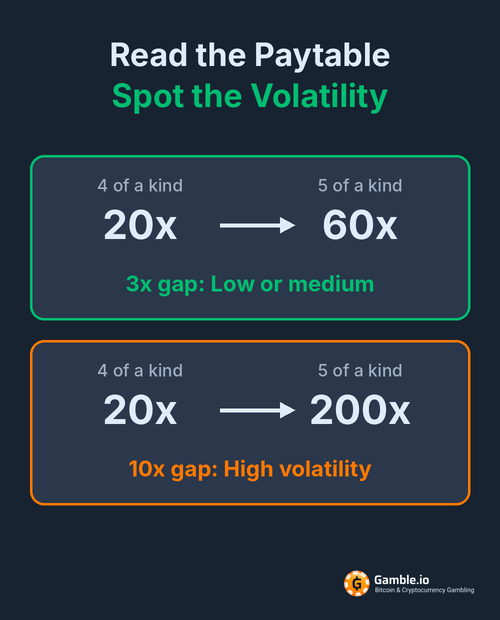
Start with the studio’s own rating, usually on its game page or in the rules. Then read the paytable for the signs.
Compare what four and five of a kind pay on one line. If five pays around ten times more, it’s likely a high volatility slot. A gap of three to five times points to low or medium.
Next, check the max win. A cap of 10,000x your bet or more usually signals high volatility.
Demo mode helps too, as long as you give it a few hundred spins. Frequent small wins suggest low volatility, while long dry spells suggest high.
Still, the full math lives in a PAR sheet, a document studios rarely publish. So the paytable is your best public clue.
RTP vs Volatility vs House Edge vs RNG
RTP is what a game pays back, and house edge is what it keeps. Volatility is how bumpy the ride is, and the RNG decides each result.
| Term | What It Tells You |
|---|---|
| RTP | Long-run share paid back |
| House edge | Long-run share kept |
| Volatility | How wins are spread |
| RNG | What each result is |
Yet no single term tells the whole story. RTP and house edge can’t tell you what a session will feel like. And volatility can’t tell you the long-run cost.
The RNG keeps the math honest. It makes every spin independent. Test labs such as GLI and eCOGRA then check both the RNG and the RTP before release.
Provably fair originals go one step further, since you can verify a single result yourself. Just know what provably fair actually proves: the result wasn’t changed after you bet.
It adds transparency, not better odds. RTP is still the long-run cost.
How RTP Affects Bonus Wagering
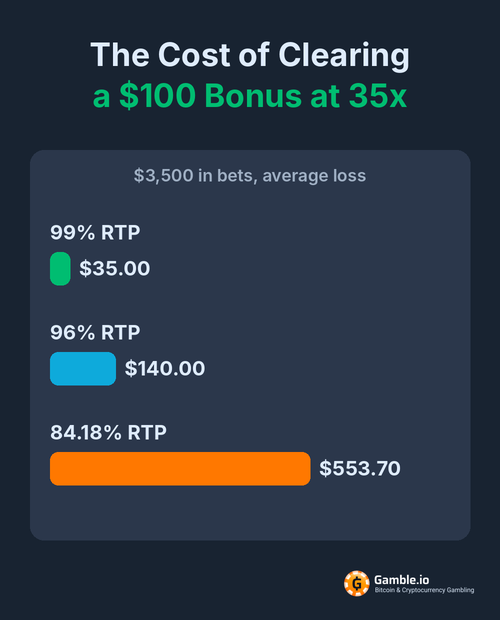
Wagering requirements turn a bonus into a long session, and the RTP sets what that session costs on average.
Take a $100 bonus at 35x. That’s $3,500 in bets before you can withdraw.
At 96% RTP, you’d expect to lose $140 clearing it, which is more than the bonus itself. At 99%, the expected cost drops to $35.
The version you play counts here too. The same $3,500 on Book of Dead costs $132.65 at 96.21%, but $553.70 at 84.18%.
That’s why casinos limit where you can clear a bonus. Slots usually count 100%, while table games often count 10% or nothing. Many terms also block high-RTP slots, so check the excluded games in casino bonus terms first.
Even no deposit bonuses for slots players carry wagering, so run the same math before you claim one.
- Gamble.io Pro Tip: Read the excluded games list before you claim. The slot you planned to play may not count toward wagering at all.
Remember, these figures are averages. A short session can land well above or below them.
Choosing Games by RTP and Volatility
Pick a volatility that fits your budget and session length. Then pick the highest RTP version of a game within it.
Casual players
Low volatility suits a small budget and a long session. Frequent small wins keep your balance going.
High rollers
High volatility suits a bigger budget that can ride out dry spells. The wins come rarely, but they can be large.
Middle-ground players
Medium volatility balances the two. You get decent wins without the steepest swings.
Jackpot chasers
Progressive jackpots carry the lowest RTPs and the longest odds. Play them for the prize, and accept the higher cost.
| Slot | RTP | Volatility |
|---|---|---|
| Starburst (NetEnt) | 96.09% | Low |
| Blood Suckers (NetEnt) | 98% | Low |
| Gonzo’s Quest (NetEnt) | 96% | Medium |
| Wolf Gold (Pragmatic Play) | 96.01% | Medium |
| Gates of Olympus (Pragmatic Play) | 96.50% | High |
| Book of Dead (Play’n GO) | 96.21% | High |
| Mega Moolah (Games Global) | 88.12% | Medium |
Each figure is the default version. Mega Moolah’s 88.12% looks low because part of every bet feeds the jackpot. Try any of these in demo mode, then look for them among the slots at crypto casinos we’ve reviewed.
And set a loss limit before you pick a game. No RTP protects a bankroll with no ceiling, so start by setting a gambling budget.
RTP Meaning FAQ
What does RTP stand for?
RTP stands for Return to Player. It’s the share of all money bet on a game that the game pays back over time. A 96% RTP slot keeps 4% on average.
Is RTP calculated per spin or per session?
It’s neither. RTP is a long-run average across millions of spins from every player. Your own session can land far above or below it, and volatility decides how far.
Can a casino change a slot’s RTP?
Not on a single spin, but a casino can choose which version to run. Many studios certify one slot at several RTPs, so check the info panel before you play.
Does a higher RTP mean more frequent wins?
No, that’s volatility. RTP tells you how much a game returns over time. Volatility decides how often it pays, so a high-RTP slot can still go a long time without a big win.
What’s the RTP on crypto dice and other originals?
Most in-house dice, plinko, and limbo games return about 99%, which is a 1% house edge. Casinos usually show the edge on the game screen, and it can vary by site.
Is RTP the same as house edge?
They’re two views of the same number. House edge is the share a game keeps, so a 97.30% RTP roulette wheel has a 2.70% edge. Slots usually quote RTP instead.
Are online casinos cheating with RTP?
Not on the spin itself. The RTP comes from the studio’s certified math, and test labs check it. The real risk is a casino running a lower certified version.
What’s a good RTP for an online slot?
Most online slots sit between 94% and 97%, so 96% is about average. On a slot without a progressive jackpot, anything under about 94% usually means a reduced version.